Log In / Register

 Canadian owned & operated. Products proudly made in Ontario, Canada >>
Canadian owned & operated. Products proudly made in Ontario, Canada >>
If you walk through a well-designed plaza, downtown, or commercial property, you'll notice one thing, that the space feels intentional. Clear walkways, clean lines, and greenery placed right where it adds the most impact. It's not accidental. In many cases, it actually comes down to the strategic use of commercial outdoor planters that businesses and municipalities rely on.
Yes, planters hold flowers, but they do more than that. They shape first impressions. For instance, a row of city planters along a sidewalk makes a street feel more cared for, active, and vibrant. Also, a few extra-large outdoor planters at an entrance signal professionalism before a visitor steps inside. Even the smallest of touches can help increase foot traffic, make public spaces feel more welcoming, and improve dwell time.
The best part is that planters are one of the easiest ways to improve a space without any major construction. With the right setup, they provide low maintenance beautification that works across seasons, helps make shared spaces feel more polished, and supports local identity.
Some people might think that a planter is a planter, but there's a big difference between a decorative container for a backyard patio and a planter designed for a public or commercial environment. Commercial planters are specifically built for high traffic outdoor spaces, as they're designed to handle weather, vandalism concerns, daily use, and simply the wear and tear that comes with public exposure.
Some of the key differences are that commercial planters are made with stronger materials that can handle Canadian winters and UV exposure, they feature larger sizes that create great visual impact in open spaces, they have structural strength for long term performance and stability, and they feature designs that are suitable for parks, plazas, sidewalks, entrances, and shared spaces of all sorts.
Unlike most residential options, commercial planters for commercial properties are designed to perform over many years, not just a few seasons. They need to stay stable, look good, and support healthy plants while also reducing maintenance needs. This is very important for BIAs and municipal streetscapes where planters are exposed to constant use and need to maintain a clean and professional appearance.
One of the reasons that streetscape planters are so widely used is their flexibility. They work virtually anywhere.
BIAs or business improvement areas often rely on BIA planters to create an attractive and cohesive streetscape. They help soften hard urban surfaces, they unify storefronts, and create a more inviting environment for pedestrians. When it comes to busy downtown cores, planters also make sidewalks feel more organized and visually connected.
Municipalities often use city planters to add seasonal color, define gathering areas, and improve public spaces without requiring any permanent landscaping. Planters can easily be placed near pathways, benches, playgrounds, civic buildings, public squares, and waterfronts.
Retail environments especially benefit from extra-large outdoor planters at entrances that guide visitors through spaces. Large planters are ideal for breaking up wide concrete areas, framing storefronts, and making plazas feel less empty.
Mixed-use developments, commercial campuses, and office buildings often use commercial planters to improve curb appeal while simultaneously defining outdoor spaces. They're ideal for framing main entrances, courtyards, patios, seating areas, and pedestrian routes.
Festivals, patios, seasonal displays, and temporary markets can all benefit from movable commercial outdoor planters that Canada suppliers provide. They make it easy to adjust layouts without having to install permanent infrastructure.
There are many benefits of commercial outdoor planters. There's a reason why so many of them show up in virtually every well-designed public space, as they solve a variety of practical problems.
Simply put, a space with greenery feels much more welcoming. Even just a couple of well-placed commercial planters can turn a plain sidewalk, entrance, or Plaza into a much more polished environment
Next, planters also act as subtle dividers. They help create outdoor seating zones, guide people through a site without the need for fencing or permanent barriers, they frame patios, and they create outdoor pedestrian zones.
Streetscape planters are often used in BIAs to reflect local branding through color choices, custom finishes, or planting styles. This is ideal for building a recognizable identity that provides the area with a cared for and community focused feel.
City planters that are strategically placed also help direct movement naturally. They help keep people away from vehicle zones and guide them towards entrances, while reducing clutter in high traffic areas.
Planters are also very flexible seasonally, with them often being used for spring and summer flowers, for fall grasses and foliage, for winter greenery and decorative branches, holiday displays, and event specific planting or decor. That kind of flexibility makes them useful beyond just one season.
One of the best upgrades that delivers consistently is the commercial self-watering planter. Traditional planters require frequent watering, which means scheduling, labor, ongoing maintenance costs, fuel, and time wasted. If you multiply this across dozens or even hundreds of locations, the workloads and wasted money adds up quickly.
First, instead of having to water planters daily during hot weather, commercial self-watering planters typically need attention just once or twice per week. This makes a big difference for municipalities, BIAs, and property managers that manage multiple locations.
Fewer trips for watering also mean lower vehicle use, better resource management, and less staff time wasted. For large scale streetscape programs, those savings are substantial when it comes to many seasons.
Another big benefit of self-watering planters is that they keep plants healthier for much longer, as consistent moisture helps plants thrive. This leads to fewer replacements, fuller displays, and better visual results from spring all the way through fall.
For commercial property groups, BIAs, and cities managing many sites, commercial self-watering planters provide a great deal of consistency. The bottom line is that maintenance teams can work much more efficiently, with each location getting a more reliable planting system. If you factor in long term maintenance savings, self-watering planters can actually be one of the smartest and most cost-effective upgrades in a commercial beautification program.
Next, you have to choose the right commercial planter, as they're not all created equal. Choosing the right option will depend on how the plant will be maintained, what kind of impact the space needs, and where the planter will go.
Yes, size does matter here, and in this case, extra-large outdoor planters are ideal for creating strong visual impact at plazas, entrances, wide sidewalks, and open areas. Smaller units can also work well in tighter spaces or as part of a layered layout. A few common considerations to keep in mind as far as size is concerned include visibility from the street, available sidewalk width, pedestrians, root space for plant health, and wind exposure for stability.
Commercial environments require durable materials, with common options including recycled plastic for weather resistance and low maintenance, steel for strength and a modern look, or fiberglass for a clean finish and lighter weight. Which material you choose really depends on your budget, climate, design goals, and how exposed the plants will be.
Something else to consider is if you want a fixed or movable planter. Fixed planters are generally best as far as stability and security are concerned, whereas movable planters are best for events, plazas, patios, and seasonal layouts that require flexibility.
Proper drainage is essential for plants, especially in Canadian climates. Poor drainage damages plants and shortens the life of planters. Integrated irrigation, like that found in commercial self-watering planters, makes maintenance much easier and it helps keep displays healthier for longer.
Finally, Canada features freeze thaw cycles, snow, salt, rain, wind, and summer heat all in one year, and that can be hard on outdoor products. This means that choosing the right planter designed for these outdoor conditions will help prevent warping, cracking, fading, and early replacement.
Buying Canadian is important, and this is true whether you're a property manager, BIA, or municipality.
Working with Canadian manufacturers helps reduce delays, particularly during spring and summer when demand increases. Having shorter supply chains means that planning is easier and this helps projects stay on schedule.
Buying domestically also helped reduce exposure to exchange rate changes, import costs, and tariff related surprises. It all comes down to cleaner and easier budgeting.
Canadian made commercial outdoor planters are designed with local conditions in mind, and this matters when it comes to freezing temperatures, road salt, strong sun, and heavy public use, all of which you'll find in Canada.
The other fact is that choosing Canadian made commercial planters helps support local jobs, domestic manufacturing, and regional suppliers. For public projects, this can also align with procurement goals and community values.
Different environments call for different planter strategies, with the best results coming from matching the product to the space, not trying to force one style to work everywhere.
BIAs often require branded planters that create a consistent streetscape. These planters have to be attractive, durable, and easy to maintain across many blocks. The best uses include main streets, storefront corridors, pedestrian zones, and seasonal downtown programs.
Municipalities generally require low maintenance and durable city planters that can perform across sidewalks, parks, public spaces, and civic buildings. Self-watering planters are especially useful when crews are responsible for various locations.
Retail centers also benefit from large statement planters that improve entrances and outdoor gathering areas. Extra-large outdoor planters can make shopping centers, mixed-use developments, and plazas feel much more inviting and better maintained.
Plazas often require movable or modular commercial planters that are able to change with events, seasonal layouts, pedestrian flow, and patios. Mobility is very useful when the planters serve multiple purposes throughout the year. The important note here is aligning design with function, as a planter should look good, but also needs to work long term for that specific space.
The right commercial planters do more than just decorate the space, but in fact shape how people experience it. From improving first impressions to reducing maintenance costs, the impact is both visual and operational. For commercial properties, BI's, and municipalities, investing in commercial self-watering planters that are well designed and durable is a practical move that delivers value year after year.
If you're looking to upgrade your space now is the time to look at options. Compare plans or solutions and request a quote from Classic Displays before this busy season begins.
Traditional planters may require daily watering, especially during hot summer months. However, commercial self-watering planters reduce maintenance needs, usually only requiring watering once or twice per week.
Extra large outdoor planters are ideal for most streetscapes as they create strong visual impact and better stability and open environments. Large planters also support healthy root environments which lead to fuller plant growth.
Yes, self watering planters are worth it, especially at scale, as they help reduce water use, labor, and maintenance frequency.
For commercial outdoor planters, fiberglass, steel, and recycled plastic are generally best. These materials are weather resistant, durable, and suitable for public spaces.
Yes, many of Classic Displays' commercial planters come in mobile formats, unlike competitors, which makes them useful for event spaces, seasonal activations, patios, and plazas.




Hospitals are generally associated with stress, urgency, and long hours. However, just outside of their walls lies an opportunity that many facilities are starting to take more seriously, outdoor space. When intentionally designed, these areas are more than just visual add-ons, but rather function as extensions of care, offering patients, staff, and visitors alike a place to breathe, regroup, and reset.
This is where Canadian site furniture for hospitals is important. Well selected furniture supports recovery, helps visitors manage difficult moments, and improves staff well-being. At the same time, site furniture for hospitals also has to meet strict requirements around accessibility, hygiene, safety, and durability.
Unlike generic solutions, healthcare site furniture and hospital outdoor furniture must perform in high use, high stakes environments. From constant daily traffic to harsh winters, design and materials make a difference. So, choosing commercial outdoor furniture for Canada and its specific climate ensures that installations are built for those local conditions while meeting all regulatory standards.
It's important to create outdoor areas that genuinely support patients, and this requires more than placing just a few benches. Design decisions have to prioritize comfort, accessibility, and emotional well-being.
Patients have a wide range of mobility needs, and outdoor spaces must be able to accommodate all of them. This includes those with walkers, individuals who require assistance from caregivers, and wheelchair users.
High-quality hospital outdoor seating has to be AODA compliant, with appropriate seat tights, spacing, and armrests. Accessible outdoor furniture ensures that pathways and seating areas are easy to navigate without awkward transitions or barriers.
Ergonomics are also essential, as visitors and patients often sit for extended periods, so comfort cannot be an afterthought. Good furniture supports posture and reduces physical strain allowing outdoor time to be more restorative.
Hospitals are usually quite noisy and busy, with outdoor spaces providing a rare chance for quiet time. Healing gardens, courtyards, and secluded seating areas allow patients to step away from clinical settings and take a minute to breathe.
Careful layout is very important here, with spacing between seating, natural barriers like planters, and thoughtful placement away from traffic zones all contributing to patient friendly outdoor spaces.
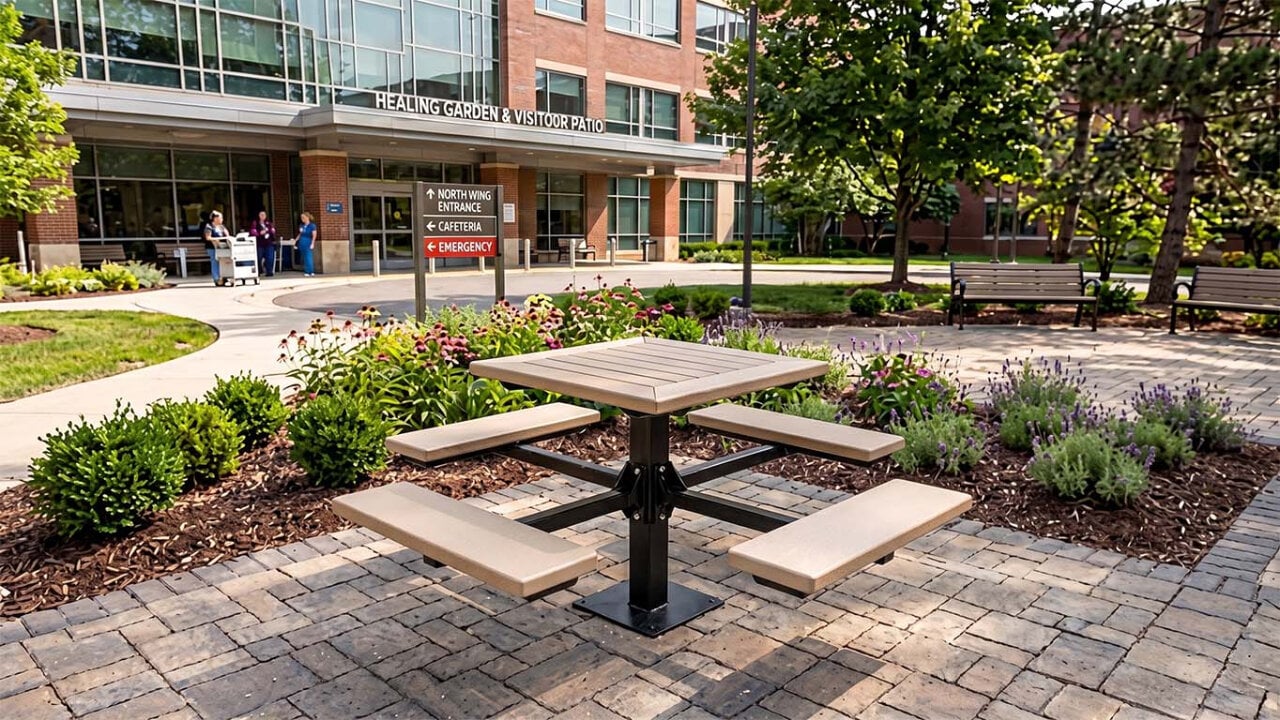
A strong example of this is the Pedestal Table, which provides stable accessible surfaces for patients and visitors without taking up too much space. It features a clean design that supports wheelchair access and easy maintenance, making it ideal for healthcare environments.
Healthcare professionals spend unimaginably long hours on their feet, often under great pressure. Therefore, outdoor break areas are not a luxury, but rather a necessity.
Even short breaks can make big differences for healthcare professionals, with the change of environment, natural light, and fresh air helping to reset focus and reduce mental fatigue. Dedicated hospital staff outdoor spaces allow workers to step away from clinical settings without actually leaving the premises, therefore supporting better performance, improved morale, and better patient care.
It is important to note that staff areas see constant use, so durability is crucial. Furniture must be able to withstand daily wear while requiring minimal setup.
Outdoor staff break area furniture has to be built with heavy-duty materials that are able to resist vandalism, weather, and repeated use.
For instance, the Urban Flare Picnic Table is a strong fit, as it offers a low maintenance, sturdy solution that holds up under heavy traffic while providing people with a comfortable space to recharge, eat, and sit.
In any healthcare setting, cleanliness is a top priority, and outdoor areas are no exception.
It's important to have proper waste infrastructure as this helps prevent litter, reduces contamination risks, and encourages compliance from both staff and visitors. Placing hospital waste containers in high-traffic areas makes sure that they are easy to access while encouraging proper disposal. At the same time, clear separation for recycling also supports sustainability initiatives.
When choosing items for waste management, the materials they are made out of must be easy to sanitize and resistant to the environment. Powder-coated metals, stainless steel, and enclosed designs are useful as they help maintain hygienic standards while resisting the harsh Canadian climate.
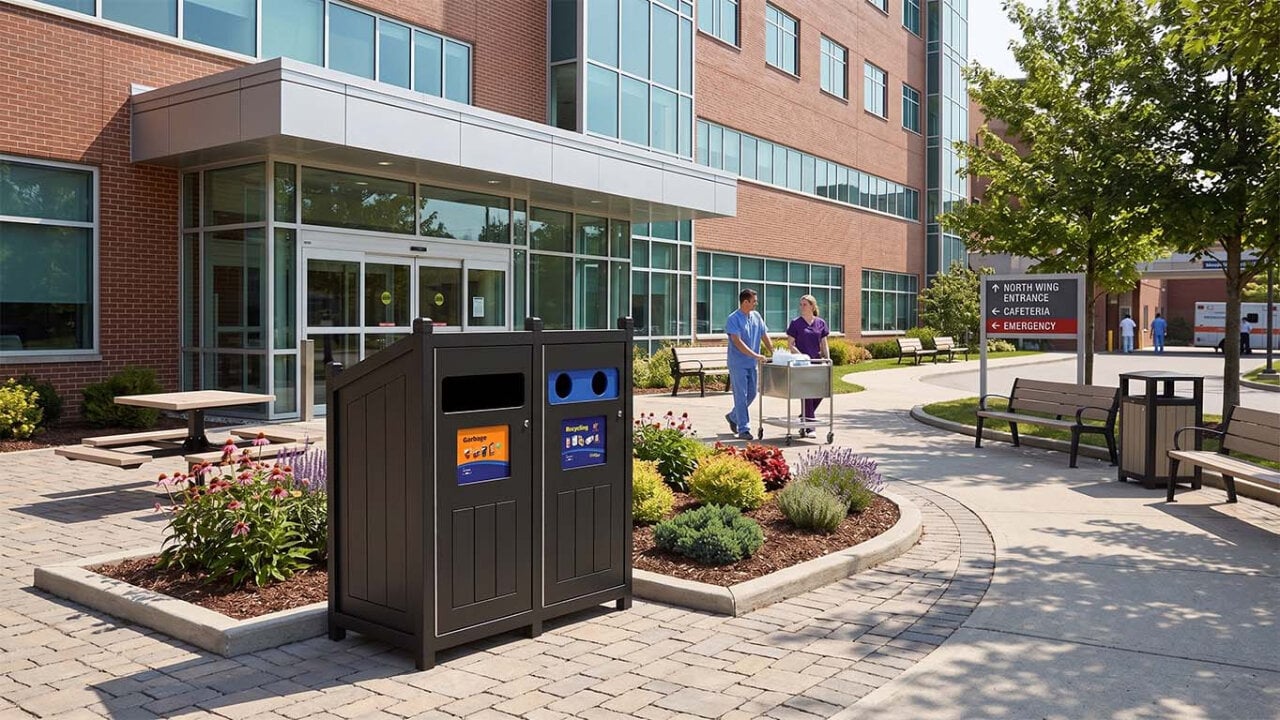
Solutions for outdoor recycling containers and commercial waste bins for hospitals prioritize both appearance and functionality. The Genesis Waste Recycling System is a good example of this, as it offers a streamlined approach to waste management. It features organized compartments that helps make it easier to maintain cleanliness across hospital grounds while also featuring a durable construction.
Moving around hospital campuses can be difficult, especially in high traffic areas with a mix of vehicles, pedestrians, and emergency access routes.
For this reason, it's important to have clearly defined walkways, as they help improve safety and reduce confusion. The strategic placement of furniture and barriers helps guide this movement without the need for signage. Using elements that support pedestrian safety infrastructure ensures that foot traffic flows smoothly, particularly near parking areas and entrances.
Bollards are important for protecting pedestrians from vehicles because they create physical separation in areas where safety is needed. High-quality hospital safety bollards and commercial bollards are designed to withstand impact while maintaining a professional and clean appearance. The Ensign Bollard, for example, is an effective solution for hospitals, as it provides strong protection without feeling intrusive.
Visits to the hospital can be emotionally taxing and very long, making outdoor waiting areas important for providing alternatives to crowded indoor spaces.
Seating near gardens, entrances, and parking areas lets visitors step outside without being too far from the hospital. Well-designed outdoor seating for healthcare facilities offers a sense of calm, especially when they're paired with natural elements like open space and greenery.
Furniture in these areas must look good over time, but it must also be extremely durable. Lower grade materials can degrade quickly with constant use, leading to a neglected or worn appearance.
Investing in hospital outdoor benches of a high quality ensures long-term durability without sacrificing aesthetic appeal. On this front, the Ergo Bench is both durable and comfortable, as it supports extended sitting while maintaining its appearance even in high traffic areas over a long period of time.
It's a fact that nature and greenery have measurable impacts on wellbeing, especially in healthcare settings.
Exposure to natural elements and plants can help reduce stress while promoting relaxation, and even the smallest addition can make notable differences. Incorporating hospital landscaping furniture into outdoor areas helps create a more inviting atmosphere for visitors and patients.
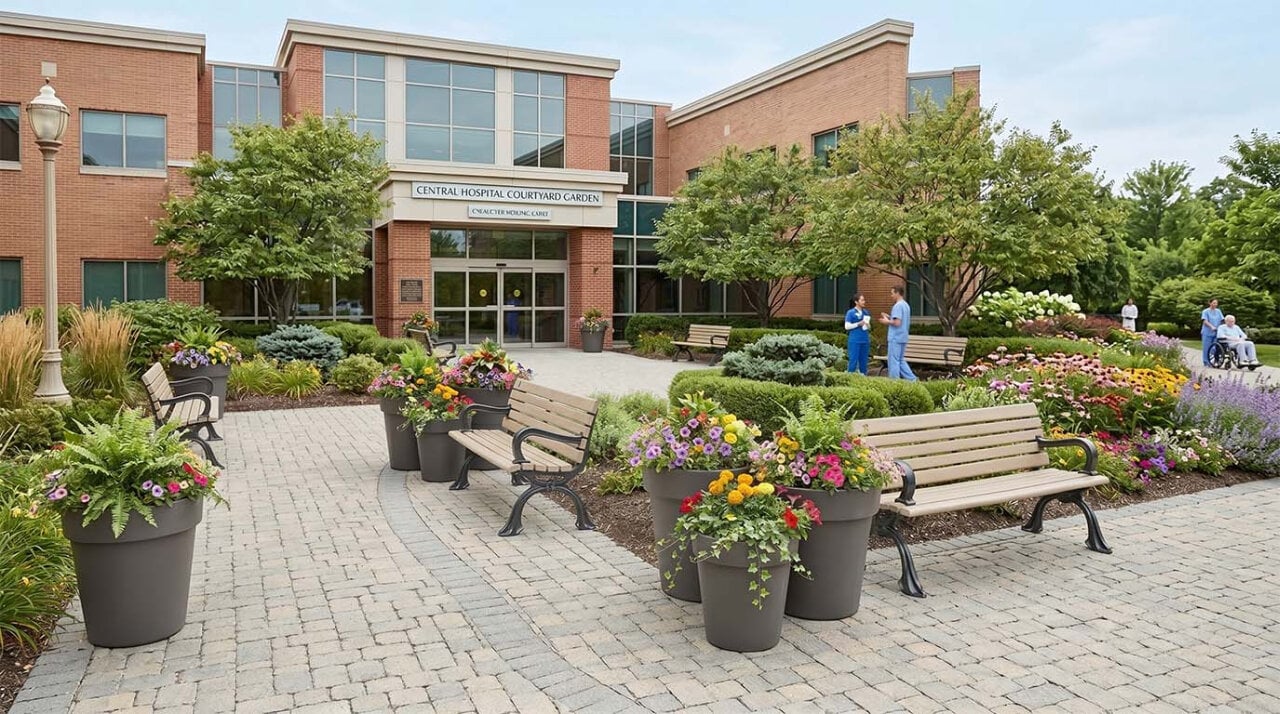
Not every hospital has the resources for large-scale landscaping projects, but this makes smaller items like planters flexible alternatives. Using commercial outdoor planters allows facilities to have greenery on the premises without making large permanent changes.
Even better, they can be repositioned, updated seasonally, and maintained with relatively minimal effort. The Hosta Self-Watering Planter is very useful in healthcare environments as it features a self-watering system that helps reduce maintenance demand while keeping plants both healthy and appealing to the eye.
Hospitals everywhere are looking to reduce parking pressure while supporting sustainable practices, making cycling infrastructure more important than ever.
Providing bike racks for hospitals helps support staff who cycle to work, and it also provides visitors with an alternative to driving, especially in urban settings. Not only does this contribute to lower congestion, but also align with broader environmental goals.
Placement of these bike racks is important, as they should be well-lit, visible, and located near entrances to encourage use and deter theft at the same time. A good example is the U30 Bike Rack Rail System, as it's a reliable option that balances security and accessibility, making it easy for users to lock their bikes safely on the premises.
There are many advantages for healthcare settings when choosing locally manufactured products.
The weather in Canada can be severe, particularly during the winter, which means that furniture must be able to withstand ice, snow, salt, and extreme temperature fluctuations. This means that investing in Canadian site furniture ensures that products are designed specifically for these harsh conditions, which results in longer lifespans and less maintenance needs.
Healthcare standards must generally meet strict safety and accessibility requirements. Products generally have to be designed to meet AODA standards, as these simplify compliance and reduce risk. One strong example of this is the Contour Bench, as it combines compliance with durability and comfort, making it suitable for many different hospital applications.
There are several factors to consider when selecting the right furniture for hospital spaces.
The main considerations to keep in mind when choosing site furniture for hospitals include durability, accessibility, maintenance requirements, and overall layout. Effective hospital outdoor furniture planning considers how people move through the space and how different elements interact with it.
Yes, initial cost is something to consider, but long term performance, maintenance needs, and replacement cycles all impact the overall value as well. A good commercial outdoor furniture selection strategy doesn't just consider upfront pricing, but also recurring costs related to the above.
When it comes to healthcare design, outdoor environments are no longer secondary considerations. They play direct roles in staff well-being, visitor experience, and patient recovery. The correct site furniture supports accessibility, cleanliness, and safety, while also transforming underused spaces into meaningful areas that support patients, staff, and visitors alike.
Make sure to choose Canadian made solutions designed for the Canadian environment, as this helps ensure compliance, durability, and performance even in the harshest of conditions. If you're planning to build or upgrade hospital spaces, the full range of site furniture from Classic Displays is a great place to start.